
By Eye Hope Clinic. Medically reviewed by Dr. Zenia P. Aguilera, ophthalmologist. Last updated October 2026.
Quick answer
It’s normal for a newborn’s eyes to wander or cross occasionally during the first few months. If your child’s eyes still turn in, out, up, or down after about 4 to 6 months of age, even only once in a while, it may be strabismus, and a pediatric ophthalmologist should check. Strabismus usually responds best when it’s found and treated early.
Key takeaways
- Occasional wandering is common in newborns. Eyes usually straighten by 4 to 6 months.
- An eye that turns in, out, up, or down after that age should be checked, even if it only happens sometimes.
- Some babies only look cross-eyed because of a wide, flat nasal bridge (pseudostrabismus). An eye exam tells the two apart.
- Untreated strabismus can lead to amblyopia (“lazy eye”), so early evaluation matters.
- Treatment may include glasses, patching or eye drops, and in some cases eye muscle surgery.
In this article
- What is strabismus?
- Is it normal for a baby’s eyes to wander?
- What if my child only looks cross-eyed?
- What signs should parents watch for?
- Why does early treatment matter?
- How is strabismus treated?
- What happens at a pediatric eye exam at Eye Hope Clinic?
- Frequently asked questions
What is strabismus?
Strabismus is a condition in which the eyes don’t line up with each other. One eye may look straight ahead while the other turns in, out, up, or down. The turn can be there all the time or come and go, for example, when a child is tired or looking at something far away.
Doctors describe strabismus by the direction the eye turns:
| Direction the eye turns | Medical term | What parents often call it |
|---|---|---|
| Inward, toward the nose | Esotropia | Crossed eyes |
| Outward, toward the ear | Exotropia | Wandering or drifting eye |
| Upward | Hypertropia | Eye that drifts up |
| Downward | Hypotropia | Eye that drifts down |
Children can be born with strabismus or develop it later. It’s often related to the muscles that move the eyes and can run in families. Most children with strabismus are diagnosed between ages 1 and 4 (Nemours KidsHealth).
Is it normal for a baby’s eyes to wander?
Yes, for a while. A newborn’s eyes can wander or cross occasionally during the first few months of life, and by about 4 to 6 months the eyes usually straighten out (Nemours KidsHealth). If one or both eyes keep turning after that, even once in a while, it’s time to have your baby’s eyes checked by a pediatric ophthalmologist. You don’t need to wait for a school vision screening.
What if my child only looks cross-eyed?
Many babies only appear cross-eyed. A flat, wide nasal bridge and small folds of skin at the inner corners of the eyes can hide the white of the eye on the nose side, especially in photos or when the baby looks to the side. This is called pseudostrabismus, and it’s very common in babies. Most children grow out of it as their face develops (American Association for Pediatric Ophthalmology and Strabismus).
Because pseudostrabismus and true strabismus can be hard to tell apart at home, and a child with pseudostrabismus can still develop true strabismus later, an eye exam is the best way to know for sure.
What signs should parents watch for?
Parents, grandparents, teachers, and pediatricians are often the first to notice that a child’s eyes don’t look straight. Watch for:
- One eye that turns in, out, up, or down, all the time or now and then
- Eyes that don’t seem to move together
- Squinting, or closing or covering one eye, especially in bright light
- Tilting or turning the head to look at things
- Complaints of seeing double (in children old enough to describe it)
- An eye that looks different from the other in family photos
When to get help right away: if an eye turn appears suddenly in an older child, or comes with double vision, headache, a droopy eyelid, or a change in behavior, call the clinic the same day or seek urgent care. Learn more on our eye emergencies page.
Why does early treatment matter?
When the eyes point in different directions, the brain can start to ignore the image from the turned eye. Over time, that eye may not develop normal vision. This is called amblyopia, or “lazy eye.” About one third of children with strabismus develop amblyopia (UF Health). Strabismus usually can be improved when it’s found and treated early, while a child’s vision is still developing. Treatment can also help older children and teens.
If your child has been diagnosed with lazy eye, read how lazy eye in kids can be treated.
How is strabismus treated?
Treatment depends on the type of eye turn, its cause, and your child’s age. A pediatric ophthalmologist may recommend one or more of these:
- Glasses: sometimes glasses alone help straighten the eyes, especially when farsightedness is part of the cause.
- Patching or eye drops: if amblyopia is present, covering or blurring the stronger eye for part of the day makes the weaker eye work harder.
- Eye muscle surgery: in some cases, surgery to loosen or tighten the eye muscles can help the eyes line up. Learn more about strabismus surgery at Eye Hope Clinic.
Children with strabismus need follow-up visits because the eye turn or amblyopia can come back as they grow.
What happens at a pediatric eye exam at Eye Hope Clinic?
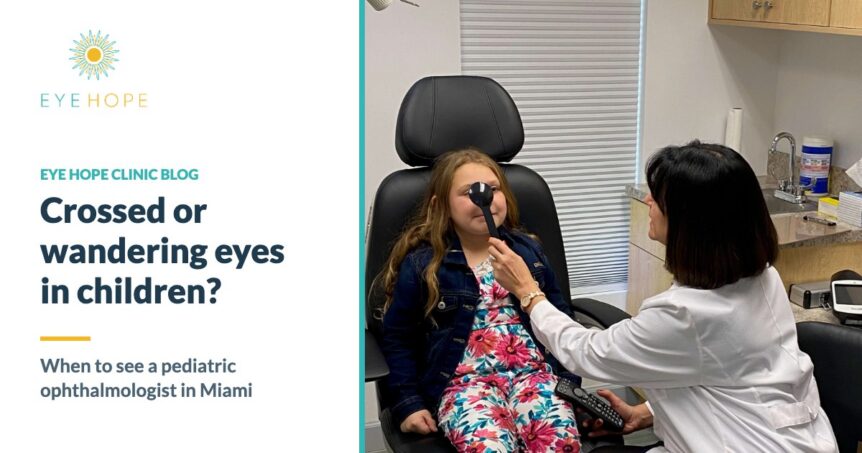
A comprehensive pediatric eye exam checks both vision and eye health. For a child with a possible eye turn, the exam also looks at how the eyes line up and move together, and whether glasses are needed. Babies and young children don’t need to read letters for the exam to work.
Eye Hope Clinic is led by Dr. Zenia P. Aguilera, who has 25 years of experience in ophthalmology and eye surgery. The clinic sees infants, children, and teens at 9655 S Dixie Hwy, Suite 102, in Miami, and welcomes families from Pinecrest, South Miami, Kendall, Coral Gables, and across South Florida. Learn more about our pediatric eye care in Miami.
Frequently asked questions
A baby who only looks cross-eyed because of the shape of the nose and eyelids (pseudostrabismus) usually grows out of it. True strabismus usually doesn’t go away on its own, and without treatment it can affect vision. An eye exam is the only way to know which one your child has.
If a baby’s eyes still cross or wander after about 4 to 6 months of age, even only some of the time, schedule an exam. For an older child, see an eye doctor as soon as you notice an eye turn.
No. Strabismus means the eyes are misaligned. Lazy eye (amblyopia) means one eye hasn’t developed normal vision. Strabismus is one common cause of lazy eye, and a child can have both.
Sometimes. For some children, glasses are enough to help the eyes line up. Others may also need patching, eye drops, or surgery. Dr. Aguilera can evaluate which treatment is appropriate for your child.
It depends on your insurance plan. Call Eye Hope Clinic at (305) 456-7035, and the office can tell you what your plan requires.
About Eye Hope Clinic
Eye Hope Clinic is an ophthalmology practice in Miami led by Dr. Zenia P. Aguilera, with 25 years of experience in ophthalmology and eye surgery. The clinic provides pediatric ophthalmology care for infants, children, and teens, along with adult eye care, from its office at 9655 S Dixie Hwy, Suite 102, Miami, FL 33156.
Noticed your child’s eye turning in or out? Call (305) 456-7035 to schedule a pediatric eye exam, or request an appointment online.
This article is for general information and isn’t medical advice. Please talk with an eye doctor about your child’s eyes.
